


One of Investing's Simplest Principles...That Most Investors Never Learn
Imagine buying two nearly identical apartment buildings.
Building A costs $10 million.
Building B costs $7 million.
They generate roughly the same rental income.
Which one would you rather own?
Almost everyone chooses Building B.
Why?
Because they're paying less for the same stream of future cash flow.
That simple idea is exactly how value investing works.
Yet when it comes to the stock market, people often do the opposite.
Investors become excited about the companies everyone else is talking about. Exciting technology. Artificial intelligence. The newest innovation. They willingly pay higher and higher prices because they believe those companies will continue growing forever.
Sometimes they do.
Sometimes they don't.
History has shown that paying a premium for popularity rarely leads to superior long-term returns.
The Market Has Been Teaching This Lesson for Nearly 100 Years
The chart below tells an incredible story.
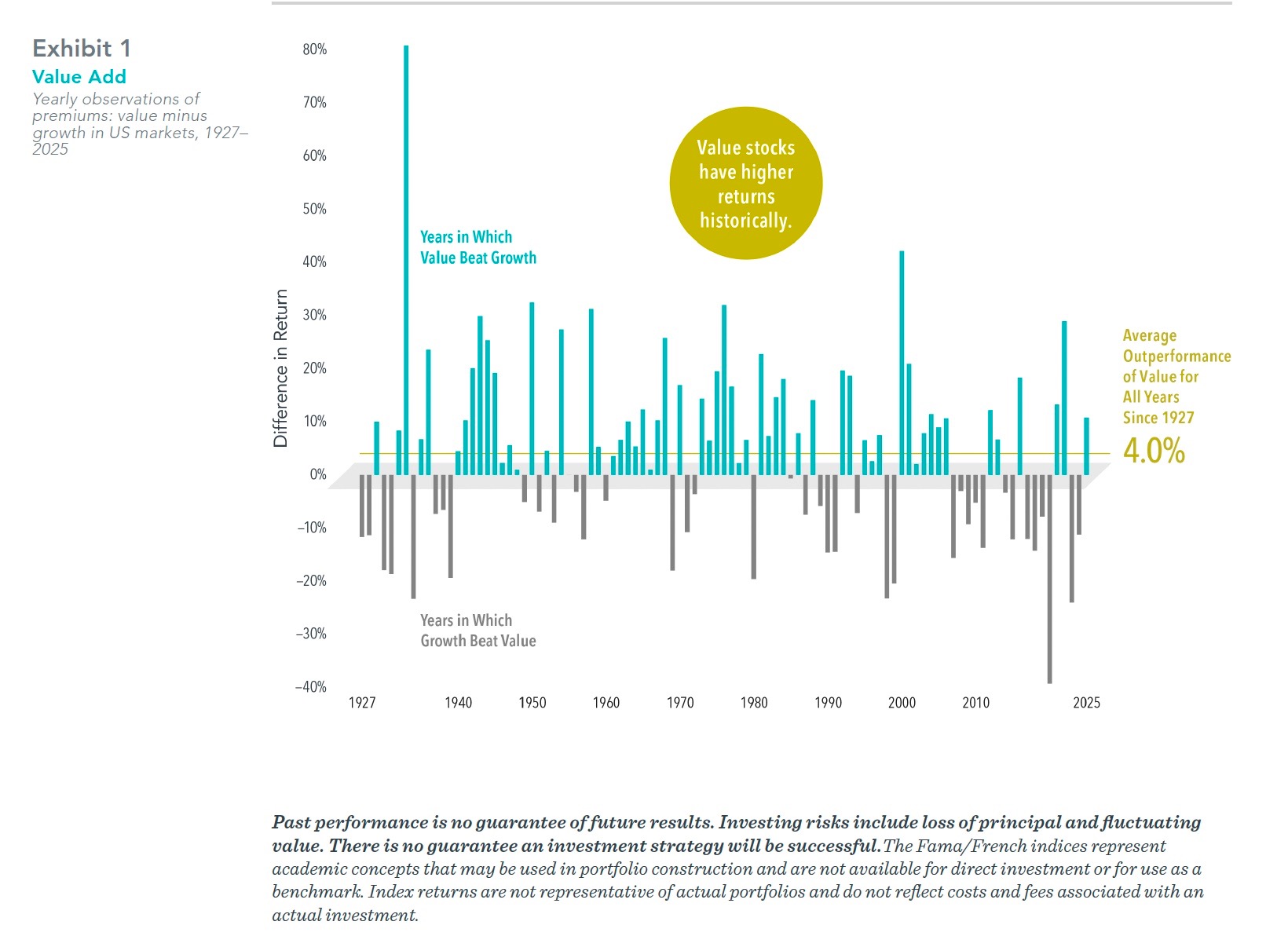
Over nearly a century of market history, value stocks—companies trading at lower prices relative to their underlying business value—have outperformed growth stocks by an average of 4% per year in the United States.
Four percent may not sound like much.
But over decades, it's enormous.
Just as remarkable...
When value does outperform, it often isn't by a little.
Historically, the average year in which value beat growth produced nearly a 15% advantage.
Those years are impossible to predict ahead of time.
Which is exactly why investors need to own value stocks before those periods arrive.
Investing Isn't About Finding the Next Winner
Many investors believe successful investing means identifying tomorrow's hottest company.
History suggests something different.
Successful investing is often about being willing to buy good companies at reasonable prices rather than great stories at unreasonable prices.
That's far less exciting.
It's also been remarkably effective.
Why This Matters
Every market cycle has its favorite companies.
In the late 1990s, it was internet stocks.
More recently, it has been artificial intelligence and the "Magnificent Seven."
Those companies may continue doing very well.
Some undoubtedly will.
But history reminds us that price matters.
Paying too much—even for an outstanding company—reduces future expected returns.
That's one of the most reliable principles in finance.
Investing Requires Patience
Notice something else about the chart.
Value doesn't outperform every year.
In fact, there are stretches where growth leads for several years.
That's uncomfortable.
It's tempting to abandon a disciplined strategy during those periods.
Yet that's often just before leadership changes.
Successful investors aren't rewarded because they react faster than everyone else.
They're rewarded because they remain disciplined while others chase yesterday's winners.
The Bigger Lesson
At Epiphany Financial Coaching, we don't build portfolios around predictions.
We build them around evidence.
The evidence tells us that investors have historically been rewarded for owning companies with characteristics associated with higher expected returns—including value companies.
No one knows what next year will bring.
But nearly one hundred years of market history give us confidence that disciplined investing remains a wiser strategy than chasing whatever happens to be popular today.
Let's Have a Conversation
If you've ever wondered why your portfolio owns certain types of companies—or whether your investments are truly positioned for long-term success—I'd enjoy sitting down with you.
Financial planning isn't about predicting the future.
It's about understanding the principles that have stood the test of time and building a strategy that allows you to invest with confidence through every market cycle.
Let's start that conversation.