


What Is “The Market,” Anyway?
Turn on the financial news and you'll hear some version of this almost every day:
“The market was up today.”
Or:
“The market fell sharply.”
But what exactly is “the market”?
Most people probably picture the U.S. stock market—the S&P 500, the Dow, or familiar companies like Apple, Microsoft, Amazon, or Nvidia.
Those are certainly parts of the market.
But they are not the market.
And understanding that distinction can change the way we think about investing.
The Market Is Much Bigger Than You Think
Take a look at the accompanying World Equity Market Capitalization illustration from Dimensional Fund Advisors.
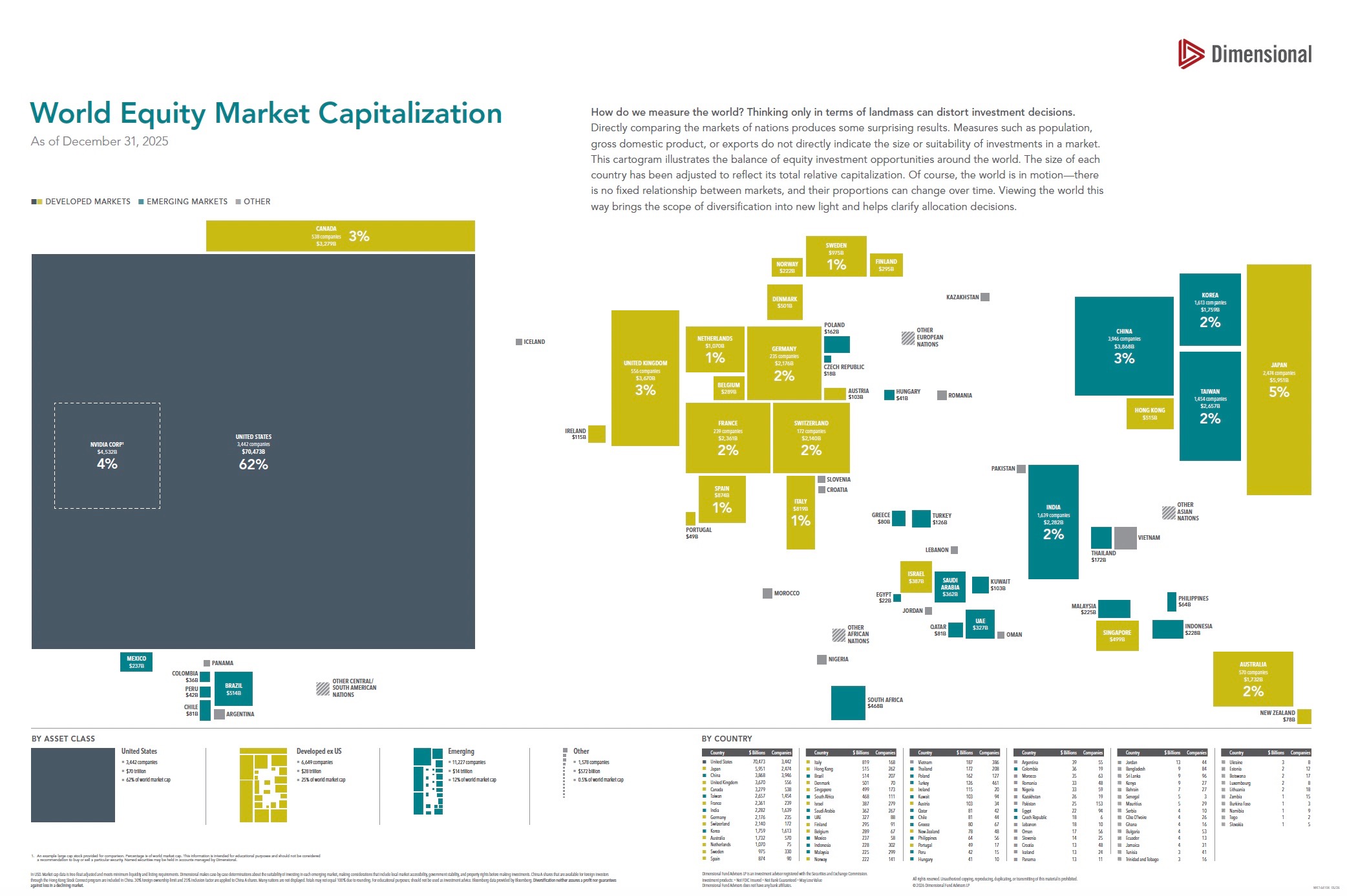
The United States represents approximately 62% of global equity market capitalization.
That's significant—but it also means approximately 38% of the world's stock market exists somewhere else.
Japan. The United Kingdom. Canada. France. Germany. Switzerland. Australia. China. Taiwan. India. South Korea—and many others.
Behind those percentages are thousands of companies employing people, creating products, developing technology, solving problems, earning profits, and competing for capital.
Collectively, that is the market.
And Stocks Are Only Part of It
Now look at Dimensional's Global Bond Market illustration.
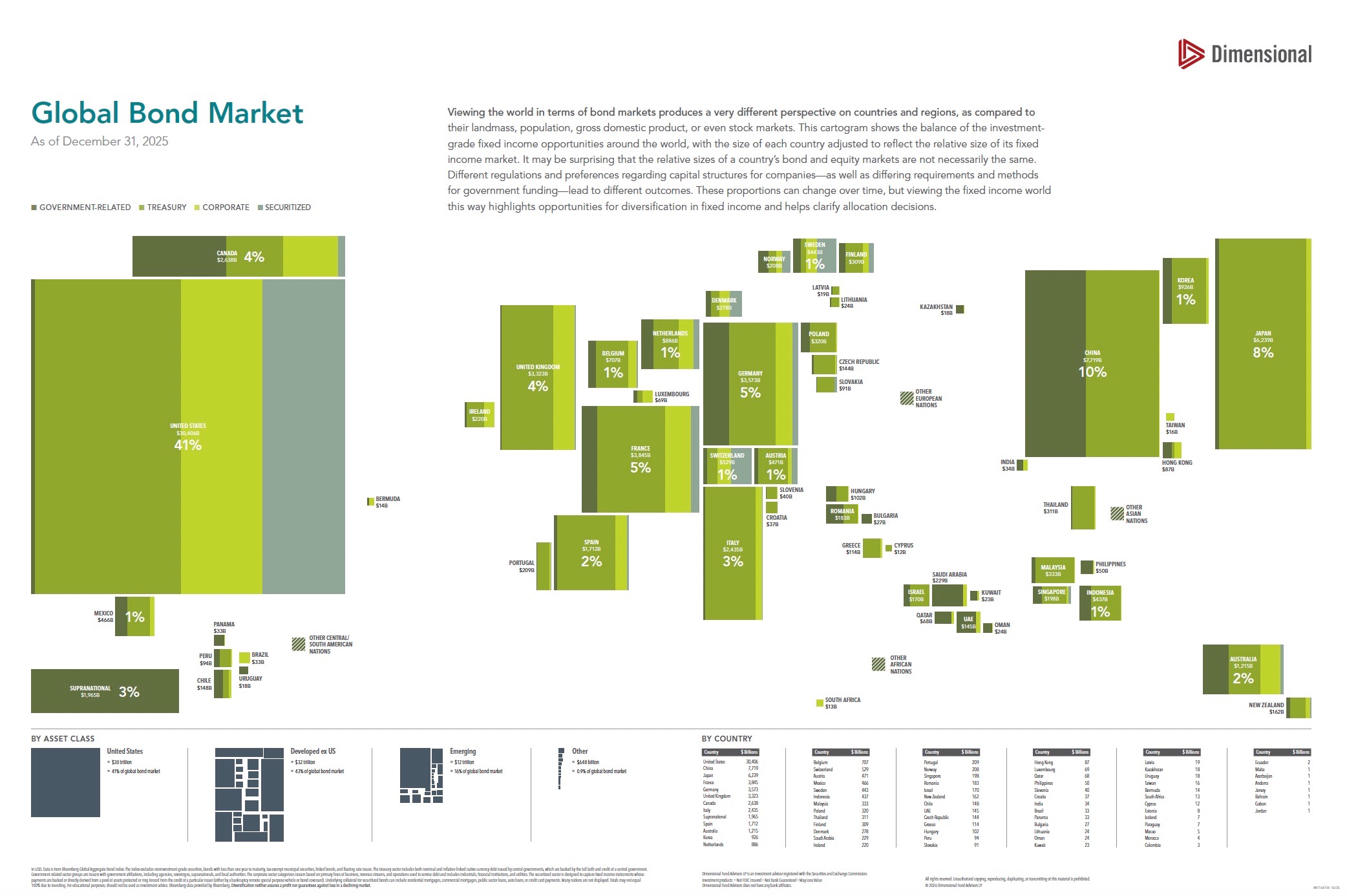
The United States represents approximately 41% of the global investment-grade bond market.
In other words, more than half of that market exists outside the United States.
When we put stocks and bonds together, an entirely different picture emerges.
The investment universe isn't 30 stocks in the Dow.
It isn't 500 companies in the S&P 500.
It is the world.
Why Does This Matter?
Because once we understand what the market actually is, we can begin asking better questions.
Instead of:
Which stock should I buy?
Which sector will outperform?
Which country will do best next year?
Should I get out until things settle down?
We can ask:
Why should my financial future depend upon my—or someone else's—ability to predict those things?
It doesn't have to.
There is another approach:
Own the market. Diversify globally. Let markets work.
We don't have to predict the next winning company, country, industry, or investment trend. We can participate broadly in the wealth-creation power of thousands of businesses around the world.
“This Is What You Own.”
These maps become especially valuable when markets get uncomfortable.
When one company, industry, country, or economic event dominates the headlines, I want my clients to look at these maps and remember:
“This is what you own.”
Not one stock.
Not one sector.
Not one country.
Not yesterday's winner.
You participate in the productive capacity of thousands of businesses around the world.
That's a very different perspective from watching the financial news and wondering what “the market” will do tomorrow.
Investing Doesn't Require a Crystal Ball
There's an enormous industry built around predictions—which stocks to buy, when to sell, where interest rates are headed, whether a recession is coming, and what markets will do next.
Some predictions will inevitably be right.
The challenge is knowing which ones beforehand.
I don't believe successful investing should require a crystal ball.
This is one reason we use globally diversified portfolios and Dimensional Fund Advisors in our investment approach.
We're not trying to find a better crystal ball. We're trying to eliminate the need for one.
My job as an advisor isn't to predict the future. It's to help clients build a thoughtful financial plan, construct an appropriate portfolio, remain diversified, manage risk, rebalance when appropriate, and stay disciplined when headlines tempt them to abandon their plan.
So, the next time you hear someone say “the market,” picture these maps.
Thousands of companies. Dozens of countries. Different industries, economies, currencies, and opportunities.
That's the market.
And we don't have to predict which small corner of it will win next.
The world is the portfolio.
Inspired by commentary from Charles Pettit of CSP Financial Group and accompanying World Equity Market Capitalization and Global Bond Market illustrations from Dimensional Fund Advisors.