


When 5% Treasury Yields Get Your Attention
When long-term U.S. Treasury yields approach 5%, investors understandably take notice.
After years of unusually low interest rates, 5% can sound pretty attractive—especially from an investment backed by the U.S. government. It can also lead to a reasonable question:
If I can earn around 5% in Treasuries, why take the risk of owning stocks?
Before changing an investment strategy, however, it helps to put today's rates into perspective.
Higher rates aren't just a U.S. story
There are plenty of explanations being offered for higher Treasury yields: inflation, federal deficits, increased government borrowing, Federal Reserve policy, and investors demanding more compensation for committing money for longer periods.
Any or all of those may be contributing.
But Dimensional's Wes Crill recently offered an important additional perspective: long-term interest rates have been rising across many major countries—not just the United States.
In fact, since January 2025, long-term rates have risen more dramatically in countries such as Japan and France than they have in the U.S. See the chart below....
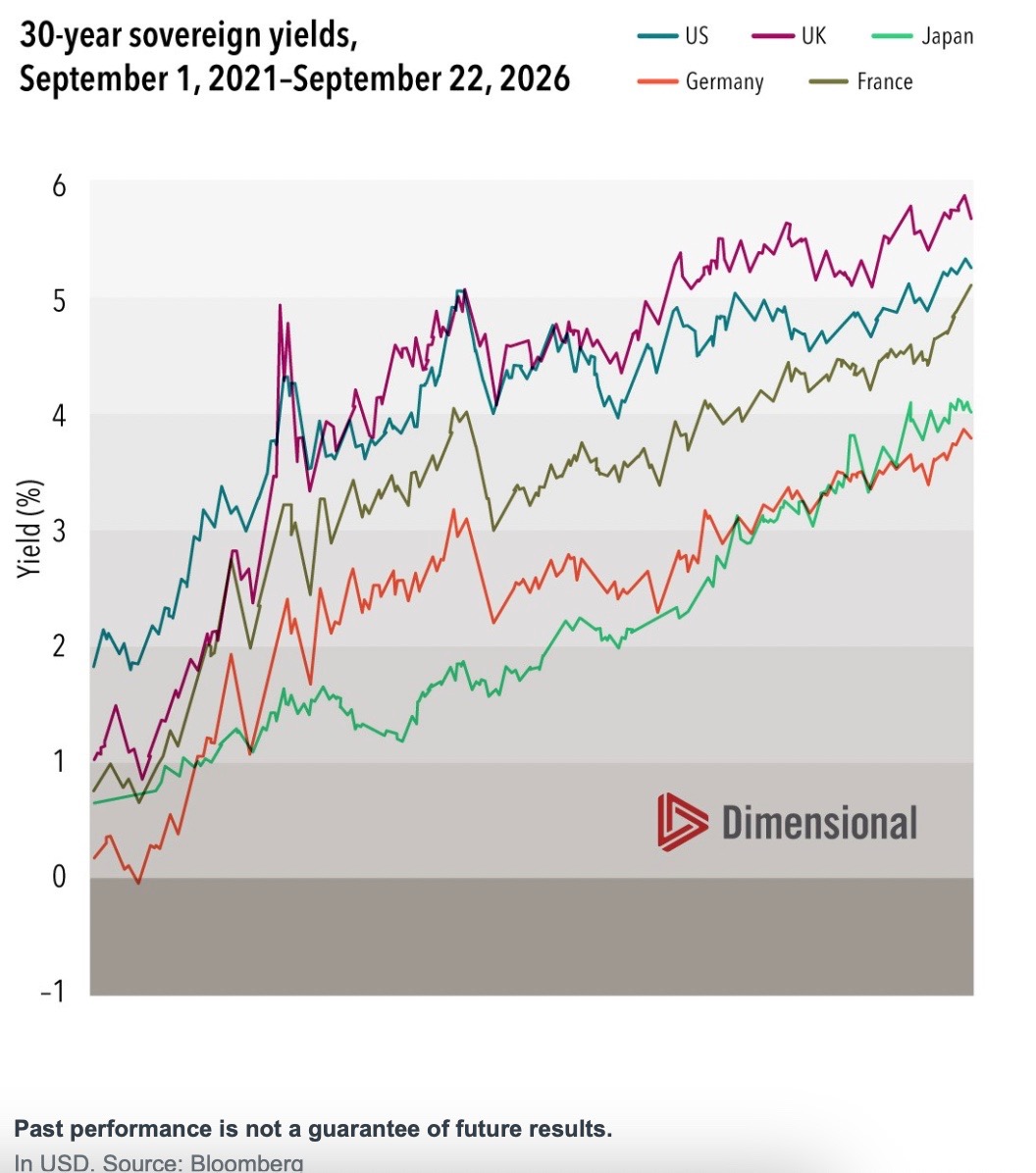
That's a useful reminder of something we talk about often: before reacting to a compelling explanation about today's markets, broaden the lens.
A higher yield doesn't mean risk disappeared
A U.S. Treasury bond has extremely low credit risk, but that doesn't mean its value can't fluctuate.
The longer the maturity of a bond, the more sensitive its price generally is to changes in interest rates. A 30-year Treasury paying an attractive yield today can experience a meaningful decline in market value if rates move higher.
That's one reason institutions such as pension funds and insurance companies are natural buyers of 30-year bonds. They may have obligations extending decades into the future and can match those liabilities with long-term bonds.
Your financial plan may have a very different job for your fixed-income investments.
For someone who needs stability, liquidity, or money available for living expenses over the next several years, shorter-term bonds, annuities, and other fixed-income strategies may serve that purpose well.
Think of fixed income as the brakes on a car—it provides stability and helps manage risk. Equities, or stocks, are more like the engine, providing the growth needed to move the financial plan forward. Good financial planning uses both: equities for long-term growth and fixed income as a buffer against the normal ups and downs of the stock market.
The goal isn't to choose between the engine and the brakes. It's to have the right amount of each for the journey ahead.
The highest available yield isn't necessarily the right investment.
What about stocks?
This may be the more important question.
If Treasury yields are around 5%, should we reduce stocks and capture that return instead?
Not necessarily.
Today's interest rates aren't a secret. They are known by buyers and sellers throughout global markets and are already part of the information incorporated into stock and bond prices.
And while a Treasury bond held to maturity offers a known return, stocks serve a different purpose in a long-term financial plan: participation in the growth and profitability of businesses and the opportunity to grow wealth beyond inflation over time.
One doesn't suddenly replace the other simply because interest rates have changed.
Information, not an instruction
Perhaps that's the most useful way to think about today's bond market.
A 5% Treasury yield is information. It isn't necessarily an instruction to change your portfolio.
Higher yields can be beneficial. They may improve expected returns from the fixed-income portion of a portfolio and create opportunities we didn't have when rates were near historic lows.
But that doesn't mean we need to predict where interest rates go next—or move money based upon today's headlines.
Instead, we can ask better questions:
- What is this money supposed to accomplish?
- When will it be needed?
- How much volatility can we reasonably accept?
- What role should stocks and bonds each play in achieving the financial plan?
That's the difference between chasing an investment and building a strategy.
Markets will continue adjusting to inflation, interest rates, government borrowing, economic growth, and countless other pieces of information.
We don't need to know which one will drive markets next.
We need to make sure the investments we own continue doing the jobs we hired them to do.