Is a higher Sharpe Ratio always better? Maybe not.
One of the most common ways investors compare investments is by looking at the Sharpe Ratio—a measure intended to show how much return an investment delivers for the amount of risk taken.
But here's the catch...
The calculation depends on price volatility. Publicly traded investments are priced every second the markets are open, so their volatility reflects real-time changes in value.
Private market investments don't work that way.
Many private investments are valued only periodically, using updated net asset values (NAVs). Because prices aren't changing every day, they often appear much less volatile—even when the underlying investments are very similar to publicly traded alternatives.
Consider business development companies (BDCs):
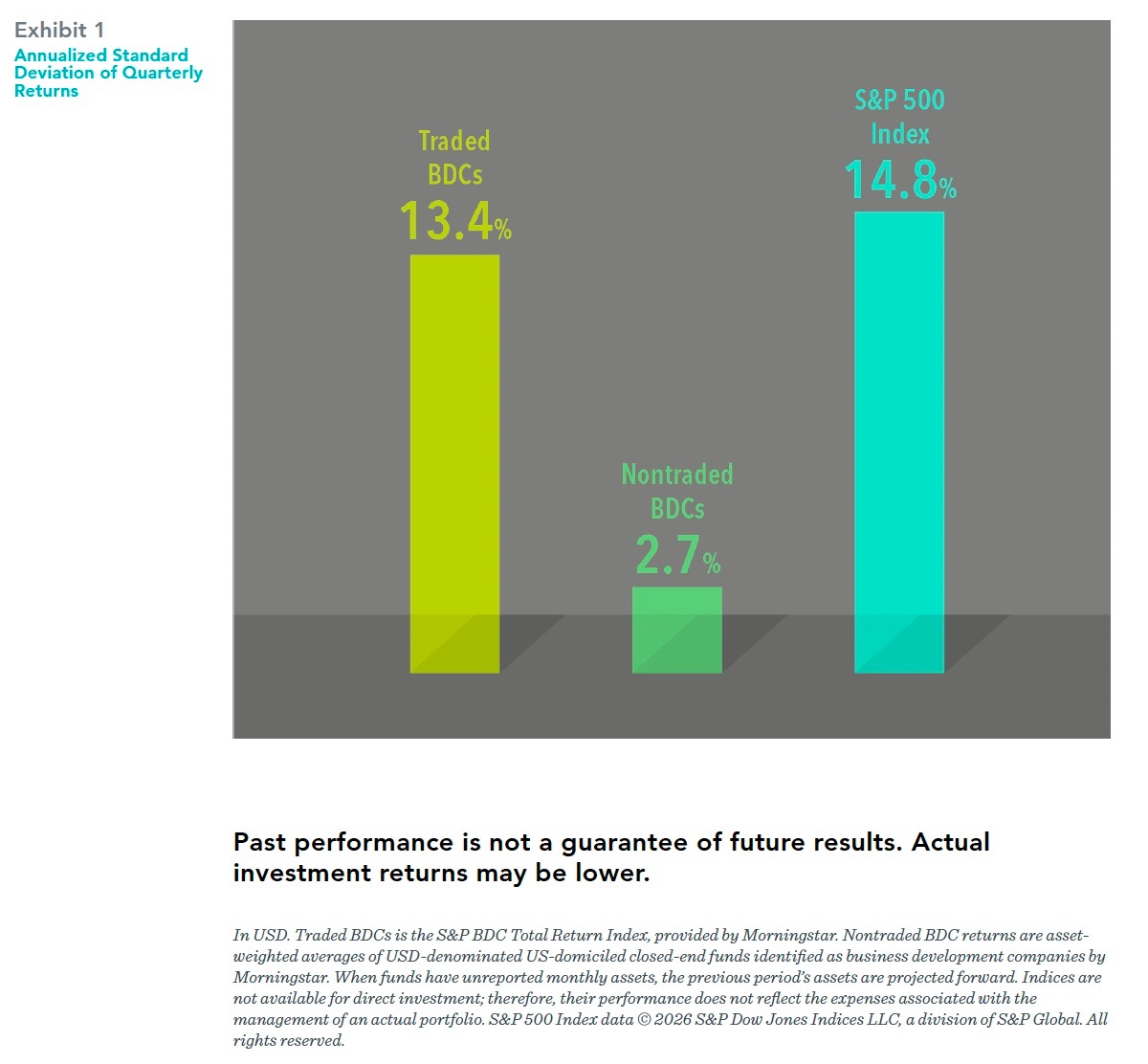
• Publicly traded BDCs showed about 13.4% annualized volatility over the past five years.
• Nontraded BDCs showed only about 2.7%.
(See Exhibit 1 below..)
Yet many own remarkably similar private credit investments.
The lesson? Lower reported volatility doesn't necessarily mean lower investment risk. Sometimes it simply means the price isn't being updated as often.
As investors, we should be careful not to mistake smoother reported returns for less risk.
Credit to Wes Crill, PhD, Senior Client Solutions Director & Vice President at Dimensional Fund Advisors, whose research continues to bring clarity to evidence-based investing.